


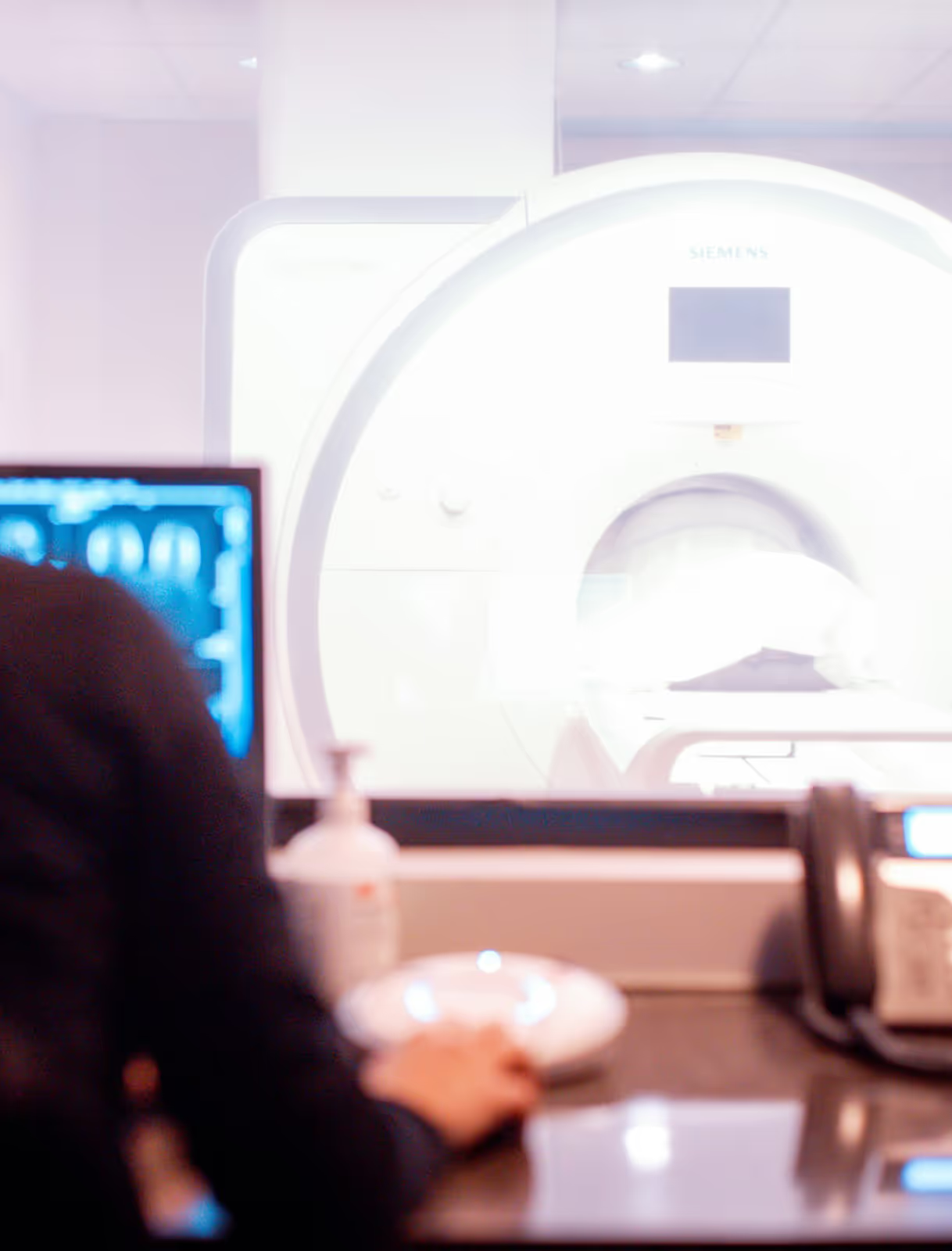
Prostate cancer can grow without any symptoms you can feel. So a good check matters when a blood test, an exam, or your own risk raises a concern. Can MRI detect prostate cancer? Yes. An MRI makes clear pictures of the prostate and the tissue around it. These pictures help doctors spot areas that do not look normal and decide if you need more tests.
A prostate MRI is often useful for men who have:
- A high PSA level. PSA is a protein made by the prostate. A blood test measures it.
- A prostate exam that was not normal.
- A past biopsy that found no cancer, but the concern is still there.
An MRI can help find tumors that may need treatment. But it cannot prove cancer by itself. You may still need a prostate biopsy. A biopsy takes tiny pieces of tissue to check for cancer cells.
AMI offers prostate MRI in Lincoln, NE. Our radiologists have extra training in their fields. A radiologist is a doctor trained to read medical images. They work with your doctor to make sense of the results and plan your care.
How Prostate MRI Helps Detect Prostate Cancer
MRI can help detect prostate cancer by showing tissue that looks different from normal tissue. Radiologists study these areas. Then your doctor can decide if a biopsy or other test makes sense.
MRI uses magnets and radio waves to make pictures of the inside of your body. It does not use radiation the way an X-ray or CT scan does.
A prostate MRI can help find small tumors that are hard to feel in an exam. It can also show the doctor where to take samples in a biopsy.
Not every odd-looking area is cancer. A prostate that has grown larger, swelling, or scar tissue can look like a tumor. And an MRI can miss some cancers. So doctors read the MRI along with your PSA level, your health history, your exam, and your other tests.
Your doctor may order a prostate MRI when:
- Your PSA level is high or has gone up over time.
- A prostate exam was not normal.
- A past biopsy found no cancer, but there is still concern.
- More facts are needed about an area that does not look right.
- The doctor needs pictures to plan a biopsy or to check on cancer that has been found.
Finding an area of concern is not the same as proving it is cancer. Some prostate tumors grow slowly and may be a fit for active surveillance. That means watching the cancer closely. Others may need treatment. MRI helps doctors judge how likely it is that a cancer needs treatment. Your full checkup decides the right care.
Multiparametric MRI for Diagnosing Prostate Cancer
Multiparametric MRI is a special prostate scan. It is called mpMRI for short. It puts a few kinds of MRI pictures together. One kind shows the shape of the prostate. One shows how water moves in the tissue. One shows blood flow. Together, they help radiologists tell areas of concern apart from many changes that are not cancer.
Your doctor may order a prostate MRI:
- Before a first biopsy.
- After a biopsy that found no cancer, when PSA or other results are still a concern.
- After cancer is found, to help see how far it reaches.
In some cases, a biparametric MRI may be a fit. It is called bpMRI for short. It uses two kinds of pictures. It most often does not need contrast. Contrast is a dye given through a small tube in your arm. Your care team decides which scan is right for you.
Radiologists use a set scoring system to report what they see. A common one is called PI-RADS. It rates how likely it is that an area is a cancer that needs treatment. The score helps guide next steps. It is not a diagnosis.
A result with high concern may lead to a targeted biopsy. A result with low concern may mean watching and more checks, based on your own risk. A normal scan does not rule out cancer. That is even more true if your PSA trend, family history, or other results still raise concern.
With mpMRI, your care team has more to go on than one test result.
When Prostate MRI Guides Biopsy and Cancer Staging
Prostate MRI can help at many points in your care. It can help look into a high PSA. It can help plan a biopsy. It can help check on cancer that has been found.
In a prostate biopsy, a doctor takes small samples of prostate tissue. A pathologist looks at the samples for cancer cells. A pathologist is a doctor who studies tissue in a lab. A biopsy can show things that pictures alone cannot.
MRI can point out areas that need a closer look. In a targeted biopsy, a urologist uses the MRI to aim at the area of concern. A urologist is a doctor who treats the prostate and the urinary system. Sometimes live ultrasound pictures are used too. The doctor may also take samples from other parts of the prostate.
For some patients, MRI results may help the doctor decide if a biopsy can wait. That choice depends on your full risk. Make it with your doctor.
After cancer is found, MRI can help show if the tumor seems to stay inside the prostate or reach nearby parts. This is part of staging. Staging means finding out how far a cancer has spread.
This table shows how prostate MRI may help.
| Your situation | How prostate MRI may help | Possible next step |
|---|---|---|
| High or rising PSA | Finds areas of concern and gives more facts about the prostate | Go over the results and decide if more tests are needed |
| Past biopsy found no cancer | Checks areas that may not have been sampled before | Talk about a targeted biopsy or more watching |
| MRI shows an area of concern | Helps show where to take tissue samples | Think about a targeted biopsy guided by MRI |
| Cancer has been found | Checks how far the cancer seems to reach in and near the prostate | Talk about staging and treatment choices |
| MRI shows low concern | Gives facts that help judge your cancer risk | Think about PSA checks or more tests, based on your risk |
MRI does not decide your whole treatment plan. Doctors also look at the type of cancer, your health, and what you want. They weigh the good and bad sides of each choice. Some people need more tests even when the MRI looks good.
If your doctor orders a prostate MRI, ask how the results may change the plan for biopsy, watching, or treatment.
What to Expect From a Prostate MRI Scan
A prostate MRI makes clear pictures of the prostate and the tissue near it. It is a scan, not surgery.
Before the scan. The imaging team gives you steps for your exam. Before you come in:
- Fill out the MRI safety form. List any implants, past surgeries, or metal in your body.
- Tell the team about kidney problems, drug allergies, or a past reaction to contrast.
- Follow any steps about food, drinks, medicine, or bowel prep.
- Ask if your exam will use contrast and if you need to do anything extra.
MRI uses a strong magnet, so the safety check matters. Some implants are safe in an MRI under set rules. Others may mean you cannot have the scan. Tell the team all your health facts so they can keep you safe.
During the scan. You lie on a padded table that slides into the MRI machine. The machine makes tapping and knocking sounds. You get ear protection. The team can talk with you the whole time. Stay still so the pictures come out clear.
You may get contrast through a small tube in your arm. Not every prostate MRI needs it.
Most prostate MRI exams take about 30 to 45 minutes. Your time may vary.
After the scan. Most people go back to their normal day unless the team says not to. A radiologist reads the pictures and writes a report for your doctor.
Your doctor will go over the results. They will tell you if you need more tests, a biopsy, or follow-up checks. Ask your doctor or imaging center when your report will be ready.
Understanding Prostate MRI Results and Their Limitations
A prostate MRI report tells how the prostate looks and points out areas that may need more checks. It helps doctors judge how likely it is that you have a cancer that needs treatment. Doctors read it along with your other health facts.
With PI-RADS, each area gets a score from 1 to 5:
- PI-RADS 1 or 2: Not likely, or very unlikely, to be a cancer that needs treatment.
- PI-RADS 3: Unclear. More checks may be needed.
- PI-RADS 4 or 5: More and more likely to be a cancer that needs treatment.
These scores estimate how likely cancer is. They do not prove cancer or rule it out. Your doctor will explain what your score means with your PSA level, exam, family history, and other risks.
MRI has limits:
- It can miss cancer. Some tumors are too small or look too much like normal tissue. A normal scan does not promise there is no cancer.
- It can raise a false alarm. Swelling, a prostate that has grown larger, and other changes that are not cancer can look like a problem. A scan with a concern does not always mean cancer.
A normal or low-concern scan makes a cancer that needs treatment less likely. It does not take away all risk. Your doctor may still want more tests if your PSA stays high, your exam is not normal, or your own risks are a concern.
The next step depends on your whole health picture. Some people need a biopsy to find out if cancer is there. Others may be able to keep watching, based on their risk and results.
If you have prostate cancer, MRI can help your doctor see how far it seems to reach and talk about treatment. Choices may include active surveillance, surgery, radiation, or other treatments. Your doctor can explain the good and bad sides of each. MRI results are one part of the choice. They should not be used alone to decide on treatment.
Schedule Diagnostic Imaging With AMI in Lincoln, Nebraska
A prostate MRI can give useful facts when your PSA, your exam, or other concerns call for a closer look. It can find areas of concern, help guide a targeted biopsy, and show how far a known cancer seems to reach. That helps you and your doctor talk through your choices.
MRI has limits. You may still need a biopsy to confirm cancer. Your doctor will look at your MRI with your other tests and your own risks to plan next steps.
AMI has served the Lincoln, Nebraska community for over 20 years. We focus on quality, value, and care built around the patient. Our radiologists have extra training in their fields. They give your doctor a detailed report to help guide your care.
Did your doctor order a prostate MRI? Ask your doctor why you need the exam and how the results may shape your care. Call AMI in Lincoln with questions about our imaging services, how to get ready, or scheduling.
Request an appointment online or call our scheduling team. We are happy to help you find a time and answer questions about your visit.


