


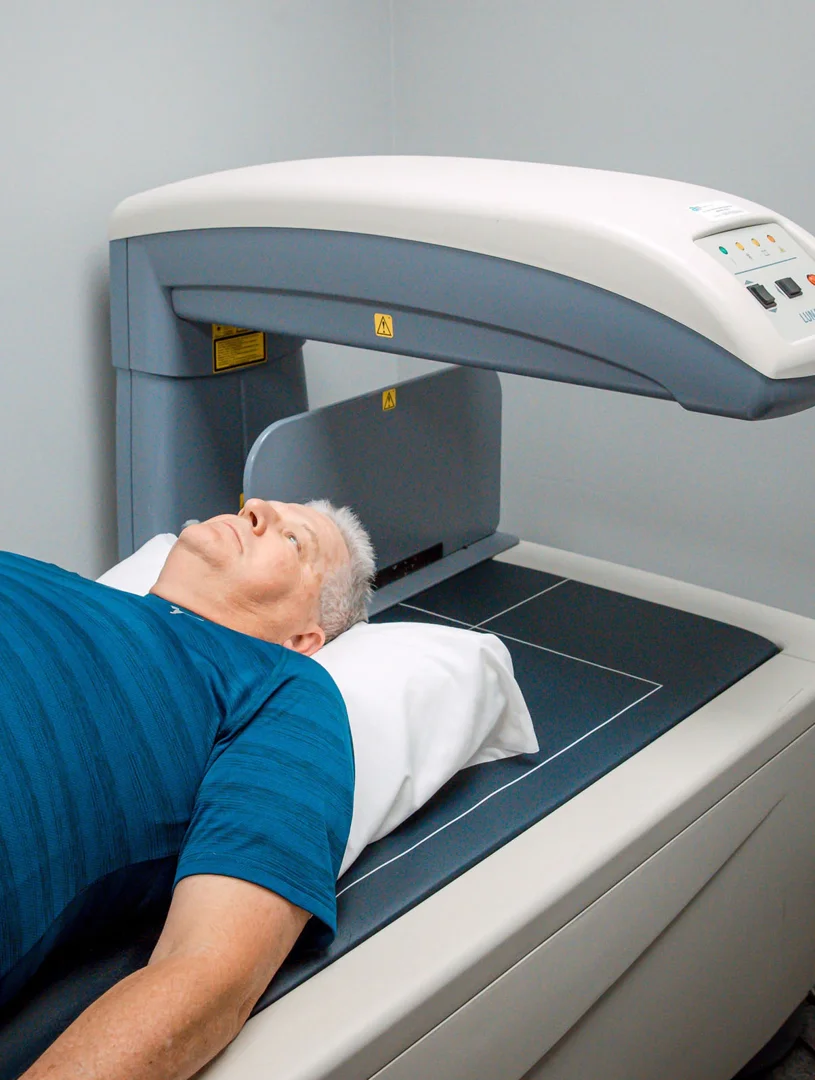
What is a DEXA scan? It's a quick, painless imaging test that uses two low-dose X-ray beams to measure the density and strength of your bones — most often at the hip and spine.
Here's what you need to know at a glance:
Bone loss is often called a "silent" condition because it causes no symptoms until a fracture occurs. Nearly 1 in 5 women and 1 in 20 men over the age of 50 are affected by osteoporosis — and many don't know it until something breaks. A DEXA scan gives you and your doctor a clear, objective picture of where your bone health stands right now, so you can take action before a problem becomes serious.
At Advanced Medical Imaging, our fellowship-trained radiologists interpret every scan with precision and care, from the moment you arrive to when your results are reviewed.
To understand what is a dexa scan, it helps to look at the technology behind the name. DEXA stands for Dual-Energy X-ray Absorptiometry. Unlike a standard X-ray that produces a simple 2D image of your skeleton, a Bone Density Scan (DEXA or DXA) uses two distinct X-ray beams with different energy levels.
One beam is absorbed primarily by soft tissue (like fat and muscle), while the other is absorbed by bone. By subtracting the soft tissue absorption from the total, our equipment can calculate your bone mineral density (BMD) with incredible precision. This allows our team to see exactly how much calcium and other minerals are packed into a specific segment of bone.
A common question we hear at Advanced Medical Imaging is about radiation safety. It is important to know that a DEXA scan uses a very low dose of ionizing radiation. According to the Facts About Bone Density (DEXA Scan) | Radiation and Your Health | CDC, the amount of radiation is actually similar to what you receive from natural background radiation in a single day. It is significantly less than a standard chest X-ray, making it one of the safest imaging tools available in modern medicine.
The primary role of this technology is to identify bone thinning before it leads to a painful break. We use it to diagnose two main conditions:
Beyond diagnosis, a DEXA scan is an essential tool for fracture risk assessment. By measuring the "thickness" of your bones, we can help your doctor predict the likelihood of a future fracture. If you are already receiving treatment for bone loss, we use follow-up scans to monitor treatment efficacy, ensuring your medications or lifestyle changes are actually making your bones stronger. For more details, you can explore more info about bone densitometry services offered by our team.
Bone health is a lifelong journey, but certain milestones trigger the need for a professional evaluation. Current medical guidelines generally recommend a baseline DEXA scan for:
Other individuals who should talk to their doctor about a scan include those who have experienced a height loss of 1.5 inches or more, people who have broken a bone after age 50, or those on long-term steroid medications (like prednisone), which are known to weaken bone tissue.
Regarding screening frequency, most health organizations recommend a repeat scan every 2 years for those at high risk. However, if your initial results are healthy, our radiologists might suggest waiting 3 to 5 years, or even longer, for your next check-up.
While bone health is the most common reason for this test, what is a dexa scan capable of beyond the skeleton? At Advanced Medical Imaging, we also offer whole-body DEXA scans to measure body composition. This provides a detailed "map" of your body, including:
Athletes often use these scans to track performance and muscle symmetry, while others use them to monitor metabolic health and resting metabolic rate. This data helps in creating highly personalized nutrition and fitness plans. You can find more info about women's center services and how we support overall wellness through advanced imaging.
One of the best things about a DEXA scan is how little preparation it requires. Unlike other tests that might require fasting or uncomfortable dyes, a DEXA scan is non-invasive and entirely painless.
To ensure the most accurate reading, we ask that you do not take calcium supplements for at least 24 hours before your appointment. On the day of the scan, please wear comfortable, loose-fitting clothing. Ideally, choose an outfit without metal zippers, belts, or buttons, as metal can interfere with the X-ray beams. If your clothing does have metal, we will simply provide a comfortable gown for you to wear.
The procedure duration is short—usually 10 to 30 minutes. You will lie on a padded table while a scanning arm passes slowly over your body. There is no "tunnel" or enclosed space, so patients who feel claustrophobic in other machines usually find DEXA very easy to tolerate. Our fellowship-trained radiologists will then analyze the data to produce your report. We know your time is valuable, so we offer same-day appointments available at our Lincoln locations.
When you receive your results, you will see two main numbers: a T-score and a Z-score. These can look a bit confusing at first, but they are simply comparisons.
According to World Health Organization (WHO) classifications:
What is the difference between a DEXA scan and a bone scan?While the names sound similar, they are very different tests. A DEXA scan uses X-rays to measure mineral density for osteoporosis screening. A "bone scan" (scintigraphy) involves injecting a radioactive tracer to look for things like cancer, infections, or hidden fractures.
Are there any radiation risks?The radiation risk is extremely minimal. However, because it does use ionizing radiation, pregnancy is a contraindication. Always let our team know if there is any chance you might be pregnant.
Which parts of the body are scanned?A "central" DEXA scan focuses on the hip and lower spine, as these are the areas most likely to experience a life-changing fracture. In some cases, we may also scan the forearm. "Peripheral" DEXA scans (often found at health fairs) only check the wrist or heel and are generally less accurate for diagnosis.
Are there accuracy limitations?While DEXA is the most accurate test available, it can be less reliable in people with significant spinal hardware (like pins or plates), severe scoliosis, or advanced arthritis in the area being scanned. Our radiologists are experts at identifying these factors and ensuring you get the most reliable data possible. For a broader look at our capabilities, see more info about imaging services we provide.
Receiving your DEXA results is the first step toward a stronger future. If your scores show bone loss, don't worry—it is never too late to take action. Many patients successfully improve their bone density through lifestyle changes like weight-bearing exercises (walking, dancing, or light weightlifting) and ensuring adequate intake of Vitamin D and calcium.
At Advanced Medical Imaging, our team of specialists is dedicated to providing the clarity you need to manage your health with confidence. We are conveniently located in Lincoln and are open 7 days a week to fit your schedule.
If you are ready to take charge of your bone health, we invite you to request an appointment at Advanced Medical Imaging today. Whether it is your first scan or a routine follow-up, our fellowship-trained radiologists and caring staff are ready to provide the high-quality care you deserve.
.png)


