


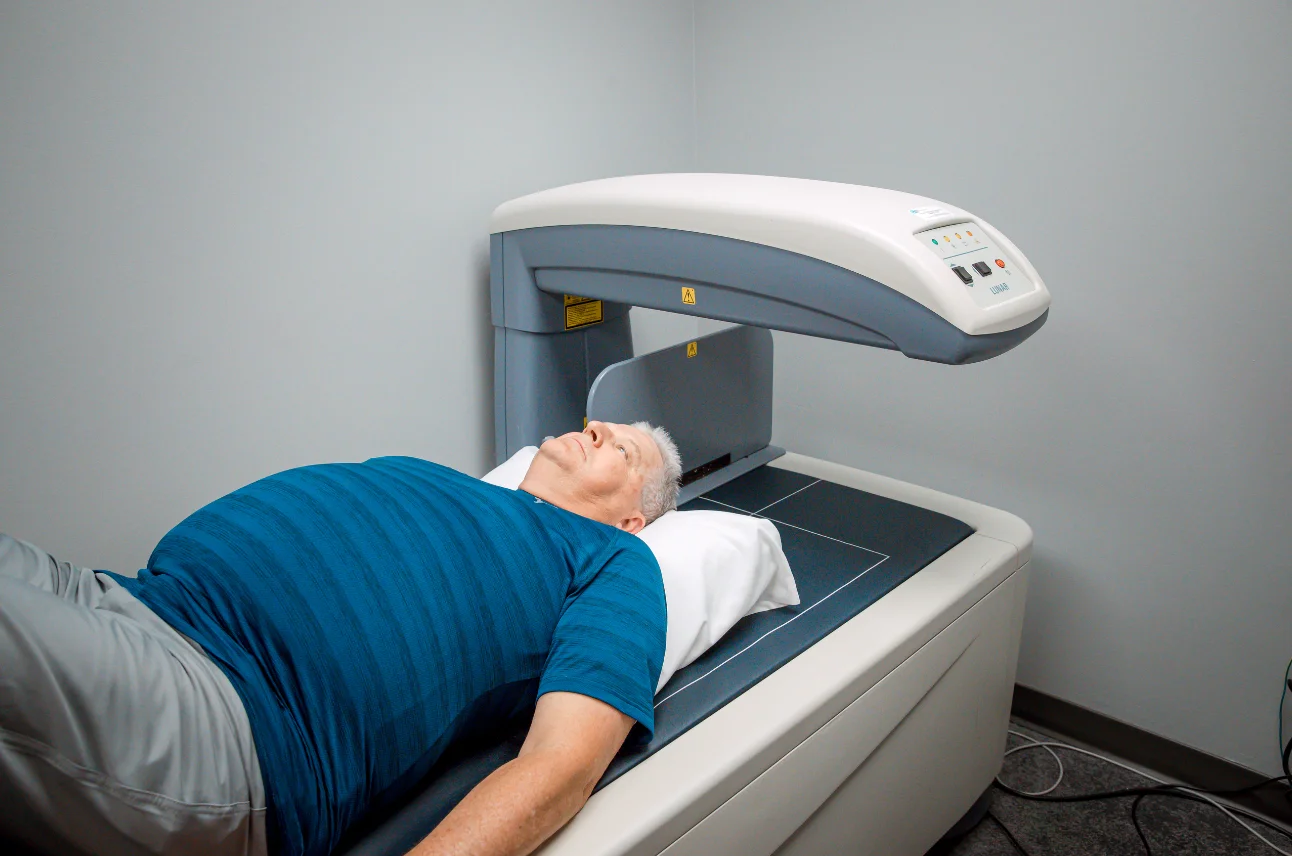
If you are taking a GLP-1 medication like semaglutide (Ozempic, Wegovy) or tirzepatide (Mounjaro, Zepbound), a DEXA scan is an important tool you can use to protect your health during weight loss. Here is what you need to know quickly:
GLP-1 receptor agonists have changed what is possible in weight loss. Medications like semaglutide and tirzepatide can help people lose 15-21% of their body weight. But here is the problem: the scale only tells you one thing — that the number went down. It cannot tell you what you lost.
Research shows that anywhere from 25% to 35% of the weight lost on GLP-1 medications can come from lean muscle mass rather than fat. And rapid weight loss from any cause can also reduce bone mineral density, particularly at the hip — raising the risk of osteopenia, osteoporosis, and fractures down the road.
A DEXA scan gives you the full picture. It is one of the most accurate methods for measuring body composition, and it is a practical way to know whether your weight loss is actually improving your health — or quietly depleting muscle and bone in the process.
At Advanced Medical Imaging, our fellowship-trained radiologists are here to help you understand your results and support your care team in making informed decisions.
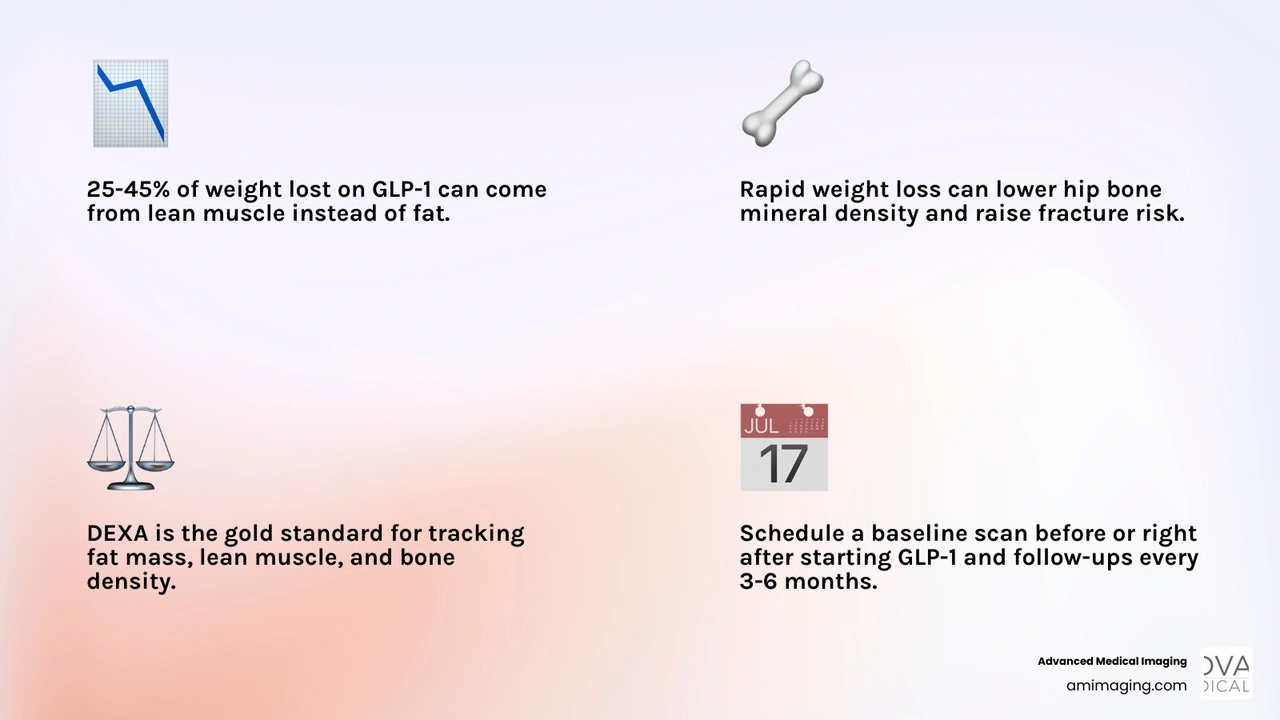
When you step on a traditional bathroom scale, you only see a single, combined number. The scale cannot tell the difference between a pound of fat, a pound of muscle, or a change in bone density. This limitation is why tracking your progress with a DEXA scan while on a GLP-1 is so essential to your long-term health.
DEXA, or dual-energy X-ray absorptiometry, uses two extremely low-dose X-ray beams to distinguish between different tissue types with incredible accuracy. It is widely recognized as the clinical standard for body composition testing. The scan provides a detailed breakdown of your body fat percentage, lean muscle mass, bone mineral density, and even regional fat distribution.
A valuable metric provided by a DEXA scan is your visceral adipose tissue (VAT). This is the deep, invisible fat that wraps around your abdominal organs. Unlike subcutaneous fat (the fat you can pinch), visceral fat is highly active metabolically and directly linked to cardiovascular disease, type 2 diabetes, and chronic inflammation. Tracking the reduction of this specific fat is an excellent indicator that your GLP-1 therapy is working to improve your metabolic health.
Without this detailed data, you might experience what clinicians call "skinny fat" or sarcopenic obesity. This occurs when a person loses a significant amount of weight but maintains a high body fat percentage because they lost a substantial amount of muscle along the way. To learn more about how this technology works, you can read our complete guide to DEXA scans.
Skeletal health is a major concern during rapid weight loss. Your bones are living tissues that constantly remodel themselves in response to physical forces. When you lose weight quickly, two primary factors can compromise your skeletal strength.
First, a lighter body reduces the mechanical loading on your skeleton. When your bones carry less weight, the natural signaling process that tells them to rebuild and stay strong is diminished. Second, rapid fat loss can lead to a reduction in circulating estrogen levels, which naturally accelerates bone turnover and can lead to bone thinning.
This combination increases the risk of developing osteopenia or osteoporosis, particularly in postmenopausal women and older adults. Clinical studies show that rapid weight loss can lead to measurable declines in bone mineral density, especially at the hip, which is a critical site for fracture risk.
For a deeper look into the clinical research on this topic, you can read the Frontiers | Bone mineral density and turnover response to GLP-1 receptor agonists in older adults with overweight/obesity and prediabetes/type 2 diabetes: a 20-week pilot trial post hoc analysis. Monitoring these changes early allows your healthcare provider to introduce protective strategies before bone loss becomes irreversible. You can explore our specialized services on our Bone Densitometry page.
The clinical trials evaluating GLP-1 medications have consistently highlighted the risk of lean tissue loss. While these medications are very effective at suppressing appetite and helping patients achieve a calorie deficit, the body naturally pulls from both fat stores and muscle tissue for energy when calories are restricted.
In the STEP 1 trial for semaglutide and the SURMOUNT-1 trial for tirzepatide, researchers used body composition sub-studies to track exactly what kind of weight patients were losing. The findings confirmed that lean mass loss is a significant side effect of rapid weight reduction. A 2026 systematic review and real-world studies like the SEMALEAN trial have further clarified these patterns.
Additionally, real-world comparative data has revealed interesting differences between therapies, as detailed in the study on Greater lean-body-mass decline with tirzepatide than semaglutide in routine care, revealed by body-composition digital phenotyping.
Here are the key statistics from recent clinical trials and systematic reviews:
To maximize the value of your body composition data, timing is everything. You could schedule a baseline scan before you take your first dose of a GLP-1 medication, or within the first two weeks of starting treatment. This baseline scan is crucial because it establishes your starting point; without it, it is impossible to accurately determine whether the weight you lose later is coming from fat or muscle.
After your baseline, you could do a follow-up scan at the 3-month mark as a checkpoint, with additional scans at 6 and 9 months, or on whatever schedule your physician recommends. Seeing changes early gives you and your care team time to respond before significant muscle loss occurs.
Some patients worry about the radiation exposure associated with frequent scans. However, a whole-body DEXA scan uses an incredibly low amount of radiation.
A DEXA scan is not just a progress report; it is an actionable roadmap that your healthcare team can use to customize your lifestyle and medical plan. If your 3-month or 6-month scan reveals that you are losing an excessive amount of lean muscle tissue, your care team can make immediate, targeted adjustments to protect your health.
Care teams commonly look at changes to nutrition and protein intake, exercise such as resistance training, bone-supporting steps like weight-bearing activity or supplements, and in some cases the pace of weight loss or medication dosing. Those decisions belong to your prescribing provider, dietitian, or primary care physician. AMI's role is to provide accurate imaging data to support them.
Embarking on a weight loss journey with a GLP-1 medication is a powerful step toward improving your health, but managing your body composition is vital to ensuring that journey is both safe and successful. By monitoring your muscle mass and bone density with regular DEXA scans, you can lose weight with confidence, knowing you are protecting your long-term physical strength and skeletal integrity.
At Advanced Medical Imaging, our fellowship-trained radiologists are dedicated to providing clear, precise, and compassionate care. We utilize state-of-the-art technology to give you and your healthcare provider the exact data you need to optimize your treatment plan.
We are conveniently located with same-day appointments available, and we are open 7 days a week to fit your schedule. If you are ready to schedule your baseline or follow-up scan, please visit our Advanced Medical Imaging Services page to request an appointment today.
.png)


