



The early signs of alzheimers and when to screen is one of the most important questions any family can ask and the answer can make a real difference in outcomes.
Here's a quick overview of the most common early warning signs and when to act:
When to screen: See a doctor if you notice one or more of these signs in yourself or a loved one especially if they are disrupting daily life.
Almost 7 million Americans are currently living with Alzheimer's disease, and that number is expected to nearly double by 2050. What makes this especially striking is that brain changes linked to Alzheimer's. Amyloid plaques and tau tangles can begin a decade or more before any symptoms appear.
That gap between silent brain changes and visible symptoms is exactly why early recognition matters so much. The sooner a concern is identified, the sooner a person can access evaluation, treatment options, and planning support.
Memory changes are a normal part of getting older. Occasionally forgetting a name and remembering it later, or misplacing your keys and finding them again, these are typical. But memory loss that disrupts your daily life is not.
This guide is designed to help Lincoln families understand what to watch for, how Alzheimer's differs from normal aging, and what steps to take when something doesn't feel right. We're here for you every step of the way.
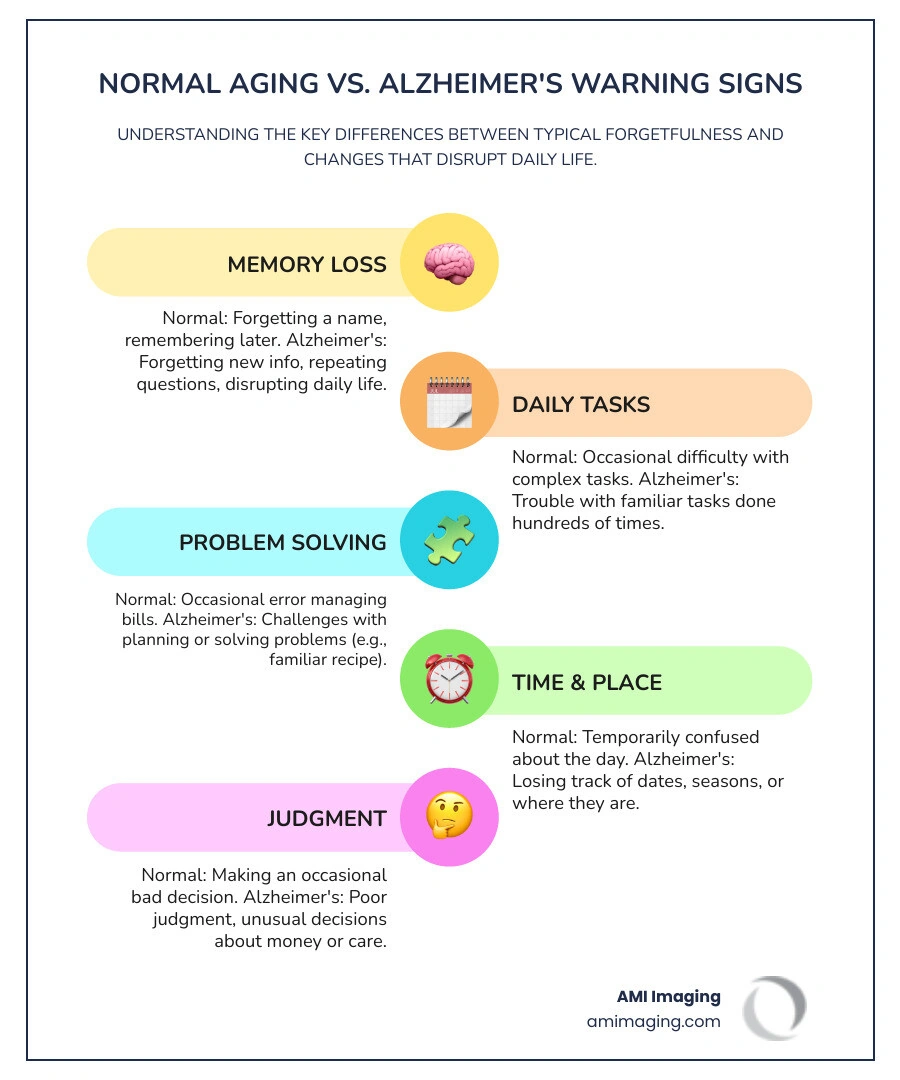
Understanding the difference between a "senior moment" and a medical concern is the first step toward proactive health management. While everyone occasionally forgets where they parked at the Haymarket, Alzheimer’s involves a persistent decline in cognitive abilities that eventually interferes with the ability to perform simple tasks.
One of the most significant indicators is a disruption in daily life. This isn't just forgetting a neighbor's name; it's forgetting the name of a close family member or how to get home from a familiar grocery store. Major health organizations, including the CDC, emphasize that memory loss is often the most visible early sign, but it is rarely the only one.
Planning and problem-solving become increasingly difficult. A person who was once a master at balancing the checkbook might suddenly find monthly bills overwhelming or lose the ability to follow a multi-step recipe they’ve made for decades. You might also notice a loved one losing track of time, seasons, or the passage of dates. They may forget where they are or how they got there, which can be a frightening experience for both the individual and their family.
Visual-spatial issues are another hallmark that often goes overlooked. This can manifest as difficulty reading, judging distances, or determining color and contrast, which can make driving particularly hazardous. Social withdrawal and personality shifts are also common; a once-outgoing person may become unusually confused, suspicious, depressed, or anxious, especially when they are outside of their comfort zone.
Before a formal Alzheimer’s diagnosis, many individuals experience what is known as Mild Cognitive Impairment (MCI). It is estimated that up to 8 million people in the U.S. may have undiagnosed MCI. This stage represents a "middle ground" between the expected cognitive decline of normal aging and the more serious decline of dementia.
When monitoring for MCI, look for frequent word-finding difficulties—where a person struggles to find the right word or calls things by the wrong name (like calling a "watch" a "hand-clock"). They might lose items often, forget important appointments, or repeat the same stories or questions within a short period.
The defining characteristic of MCI is that while these changes are noticeable to the individual and their family, they do not yet significantly interfere with daily activities or independence. However, recognizing MCI is crucial because it can be an early signal of Alzheimer’s. Early detection during this phase allows our fellowship-trained radiologists to look for specific brain changes that might indicate a progression toward dementia. You can learn more about these early markers from the Alzheimer's Association.
It is completely natural to worry when you can’t find your glasses, but it’s important to distinguish typical forgetfulness from disease progression. In normal aging, a person might make an occasional error when managing finances or household bills, but they are generally able to catch and correct the mistake. In contrast, someone with early Alzheimer’s may lose the ability to manage a budget entirely.
A person experiencing typical age-related changes might forget which day it is but remember it later. Someone showing early signs of Alzheimer's may lose track of the date or the season and stay confused about it. Another key difference lies in the ability to retrace steps. We all misplace our keys from time to time, but a person with healthy cognitive function can usually mentally retrace their path to find them. Someone with Alzheimer’s may put things in unusual places—like a wallet in the freezer—and be unable to retrace their steps, sometimes even accusing others of stealing the item.
If you are noticing these changes, the best time to speak with a professional is now. Often, family members are the first to observe these shifts before the individual does. If you see a loved one repeating questions, showing unclear thinking, or struggling with basic judgment, it is time to schedule a consultation.
While most Alzheimer's cases are "late-onset," appearing in the mid-60s or later, early-onset Alzheimer's can occur as early as a person's 30s or 40s, though this is rare. Regardless of age, a primary care doctor is usually the first stop. They may perform basic cognitive tests and then refer you to a specialist, such as a neurologist or a geriatrician, for a more in-depth evaluation. Our team at Advanced Medical Imaging works closely with these specialists to provide the clear, detailed imaging needed for an accurate diagnosis.
The journey toward answers often involves the preclinical stage—a period where the brain is changing, but symptoms aren't yet obvious. During this time, amyloid plaques and tau tangles may be forming. These are the "hallmarks" of Alzheimer's that interfere with how neurons communicate.
Fortunately, diagnostic accuracy has improved significantly. We no longer have to wait for symptoms to become severe to understand what is happening inside the brain. Our Imaging Services provide a window into these changes, helping doctors rule out other reversible causes of memory loss, such as vitamin deficiencies or thyroid issues.
Recent research has shown that blood tests measuring specific forms of tau and amyloid can detect Alzheimer’s with 86-99% accuracy. When combined with advanced imaging, these biomarkers offer a high level of diagnostic confidence. For those interested in a proactive approach to their health, you can Unlock Early Detection with a Full Body MRI to screen for various health concerns that may impact your overall well-being.
Many people hesitate to get screened because they feel that without a cure, there is no point in knowing. However, early detection is about much more than just a label. It opens the door to FDA-approved treatments that can slow the progression of the disease and help manage symptoms.
Early diagnosis also allows individuals to:
At Advanced Medical Imaging, we understand that the prospect of an Alzheimer’s screening can be overwhelming. That is why we focus on providing a warm, reassuring environment for every patient who walks through our doors. Our fellowship-trained radiologists are sub-specialized in their fields, ensuring that your scans are interpreted with the highest level of expertise.
We believe that high-quality care should also be convenient. We are located right here in Lincoln and offer same-day appointments to help you get answers quickly. We are open 7 days a week to fit your family’s busy schedule, because we know that when it comes to cognitive health, time is of the essence.
If you or a loved one are experiencing changes in memory or thinking, don't wait for the symptoms to worsen. We're here for you every step of the way. You can Request an Appointment online today to begin the process of getting the answers you deserve.
At what age should I start worrying about Alzheimer's? While most symptoms appear after age 65, brain changes can begin 10 to 20 years earlier. If you have a strong family history or are noticing persistent cognitive changes that disrupt your daily life, it is worth discussing a screening with your doctor regardless of your age.
Can an MRI definitively diagnose Alzheimer's? An MRI is a critical tool used to identify brain shrinkage and rule out other causes of memory loss, but it is typically used in conjunction with cognitive tests, medical history, and sometimes blood or PET scans to reach a definitive diagnosis.
Is Alzheimer's a normal part of aging? No. While some slowing of thought and occasional forgetfulness are normal parts of getting older, Alzheimer's is a progressive brain disease that is not a standard part of the aging process.
What is the difference between dementia and Alzheimer's? Dementia is a general term for a decline in mental ability severe enough to interfere with daily life. Alzheimer's is a specific disease and is the most common cause of dementia.
How can I support a family member who is afraid to get screened? Approach the conversation with empathy. Focus on the benefits of early detection, such as accessing treatments that can preserve their independence and the ability to rule out treatable, reversible conditions that might be causing their symptoms.
.png)


