


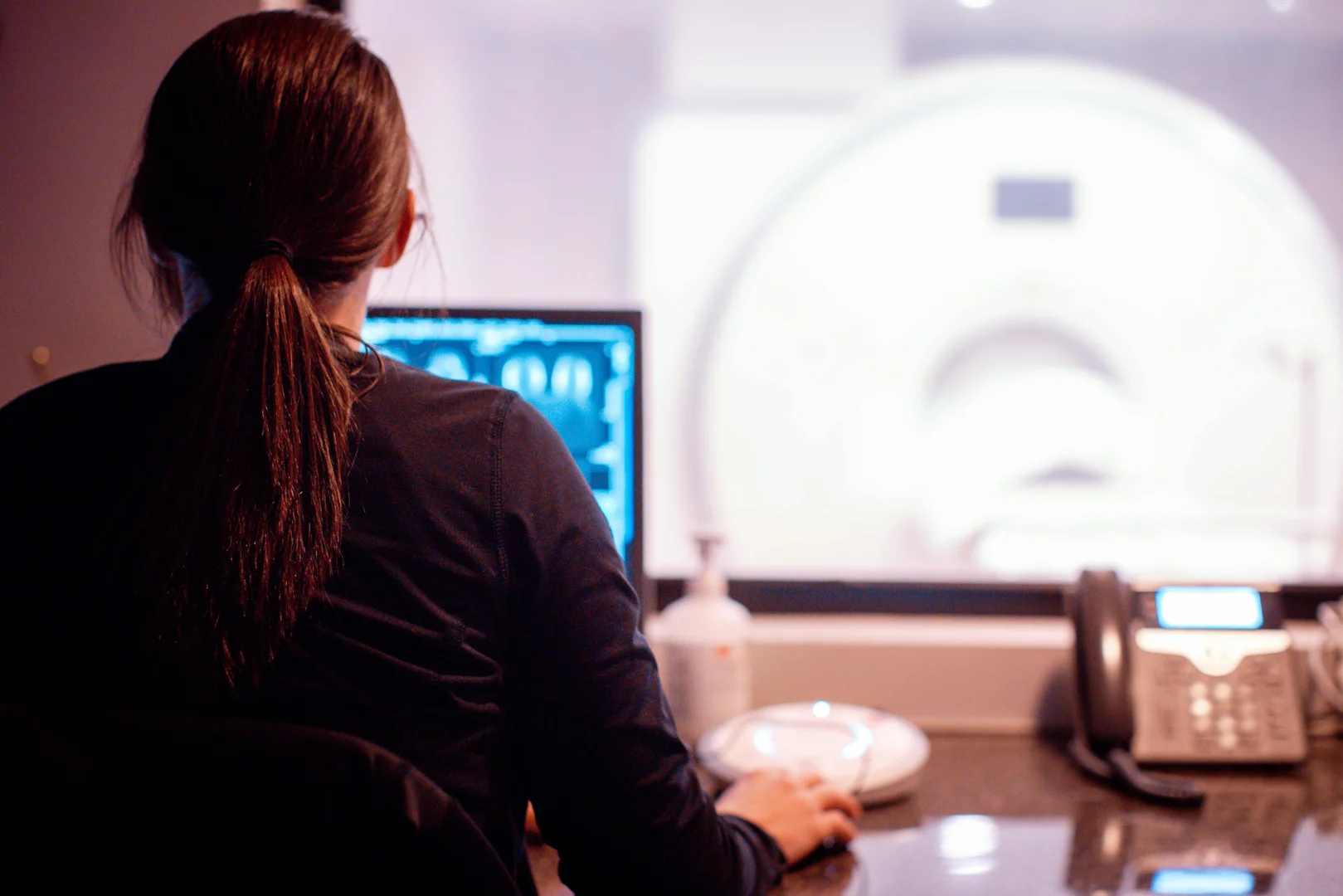
The mri vs ct scan difference comes down to technology and purpose: CT scans use X-rays to quickly image bones, organs, and dense structures, while MRIs use magnets and radio waves to produce detailed images of soft tissues — with no radiation.
Here's a quick side-by-side breakdown:
Neither scan is universally "better." The right choice depends on what your doctor needs to see and your individual health situation.
Both are non-invasive, both produce detailed internal images, and both play an important role in modern diagnosis. Understanding the difference helps you feel more confident going into your appointment — and that's exactly what this guide is here for.
When our team needs to examine your body to diagnose a health issue, we may recommend either an MRI or a CT scan. While both capture images within your body, they use different technologies to show different things. Understanding these tools helps you make informed decisions about your healthcare.
At Advanced Medical Imaging, we believe that when you understand your diagnostic journey, you feel more at ease. The primary mri vs ct scan difference lies in the energy used to create the image. One relies on ionizing radiation (X-rays), while the other uses a powerful magnetic field.
Choosing between them isn't about which machine is "newer" or "more advanced." Instead, our fellowship-trained radiologists look at the specific clinical question your doctor is asking. Are we looking for a tiny fracture in a bone, or are we investigating the subtle fibers of a ligament? The answer to that question dictates which room you’ll visit in our suite.
A CT scan, or Computed Tomography, is essentially a sophisticated evolution of the traditional X-ray. While a standard X-ray provides a flat, 2D image, a CT scanner rotates around your body, taking thousands of tiny pictures from every possible angle.
Our computer systems then "stack" these images to create 3D cross-sectional views, similar to looking at individual slices in a loaf of bread. This allows us to see "inside" organs and around bones with incredible clarity.
Because CT scans are exceptionally fast—often taking less than a minute for the actual scanning process—they are a preferred choice for emergency situations. We frequently use them to detect:
Magnetic Resonance Imaging (MRI) works on an entirely different scientific principle. Instead of radiation, the MRI machine uses a very strong magnetic field and radiofrequency waves. When you are inside the scanner, the magnets cause the water molecules in your body to align. Radio waves then "nudge" these molecules, and as they return to their original position, they emit signals.
Because different tissues (like fat, muscle, and nerves) have different water content, they send back different signals. This allows MRI to distinguish between very similar-looking soft tissues.
We typically recommend an MRI when we need to see:
The experience of sitting through each scan is quite different. A CT scan is very quick; you will usually be in and out of the room in 5 to 10 minutes. The machine is shaped like a large donut, and because it is relatively open, claustrophobia is rarely an issue. It is also a very quiet procedure.
An MRI, however, requires a bit more patience. A standard scan typically lasts between 30 and 60 minutes, though some detailed exams can take longer. You must remain very still, as even small movements can blur the high-resolution images. The machine is also famously noisy, producing loud thumping, humming, and clicking sounds as the magnets switch on and off.
We provide ear protection or headphones with music to make the experience more pleasant. If you are nervous, we have resources on how to ease your anxiety for your first MRI, and our team is here for you every step of the way to ensure you feel safe and comfortable.
Deciding which scan is appropriate is a collaborative process between your referring physician and our diagnostic imaging experts. We don't just look at the body part; we look at the whole patient.
The differences between a CT scan and an MRI often mean that one is clearly superior for a specific situation. For example, in an emergency room setting where every second counts, a CT scan is almost always the first choice because it can scan the entire chest, abdomen, and pelvis in seconds to find life-threatening bleeding.
However, for a chronic knee injury or a suspected brain tumor, the "speed" of the CT is less important than the "detail" of the MRI. MRI provides a much higher contrast between different types of soft tissues, making it easier to spot a small tear in a meniscus or a tiny lesion in the brain.
In some cases, we might even use both. A doctor might order a CT to look at the structure of a bone and then follow up with an MRI to see if the surrounding nerves or ligaments were affected.
Safety is a primary priority at Advanced Medical Imaging. When weighing the mri vs ct scan difference, we carefully consider your medical history.
Radiation Concerns:CT scans use ionizing radiation. While the doses used in modern imaging services are very low and the benefits of an accurate diagnosis almost always outweigh the risks, we are mindful of cumulative exposure. We generally avoid CT scans for pregnant women unless it is a life-threatening emergency. MRI, which uses no radiation, is often a safer alternative for children or patients who need frequent, repeated imaging.
Metal and Implants:Because the MRI magnet is always on and incredibly powerful, certain metal implants can be dangerous. Pacemakers, cochlear implants, and some types of aneurysm clips may not be compatible with the MRI environment. It is vital that you disclose all implants to our staff. Conversely, CT scans are generally safe for patients with metal in their bodies, though the metal can sometimes cause "artifacts" (blurring) in the image.
Contrast Agents:Both types of scans may use "contrast" (a special dye) to make certain structures show up more clearly. CT contrast usually contains iodine, which many people are allergic to. MRI contrast (gadolinium) is different and has a lower rate of allergic reactions, though it requires caution in patients with severe kidney disease.
Can I have a CT and an MRI on the same day?Yes, it is perfectly safe to have both on the same day if your doctor requires different perspectives for a diagnosis.
Which scan is more expensive?Generally, CT scans are less expensive than MRIs because they are faster and the equipment is less costly to maintain. However, at Advanced Medical Imaging, we provide quality imaging at outpatient prices. This means you get the same high-level technology as a hospital without the hospital markup. Although separate charges can happen, our goal is to eliminate surprise bills and fees.
How do I prepare for my scan?Preparation depends on the area being scanned. For some CT scans, we might ask you not to eat for a few hours. For an MRI, a critical step is removing all jewelry, watches, and clothing with metal zippers or snaps. We will give you specific instructions when you book your appointment.
Do I need a doctor's order?Yes, a licensed healthcare provider must order these exams to ensure the correct test is performed for your specific symptoms. Once you have an order, you can easily request an appointment at Advanced Medical Imaging.
Why choose an outpatient center like Advanced Medical Imaging?We offer a level of personalized care that large hospitals often can't match. We are open 7 days a week to fit your schedule and are conveniently located with same-day appointments available. Importantly, your scans are read by our fellowship-trained radiologists who specialize in specific areas of the body, ensuring exceptional accuracy for your results.
If you have more questions about the mri vs ct scan difference or need to schedule your exam, our team is ready to help. We’re here for you every step of the way, from the moment you call us to the moment your doctor receives our expert report.
.png)


