


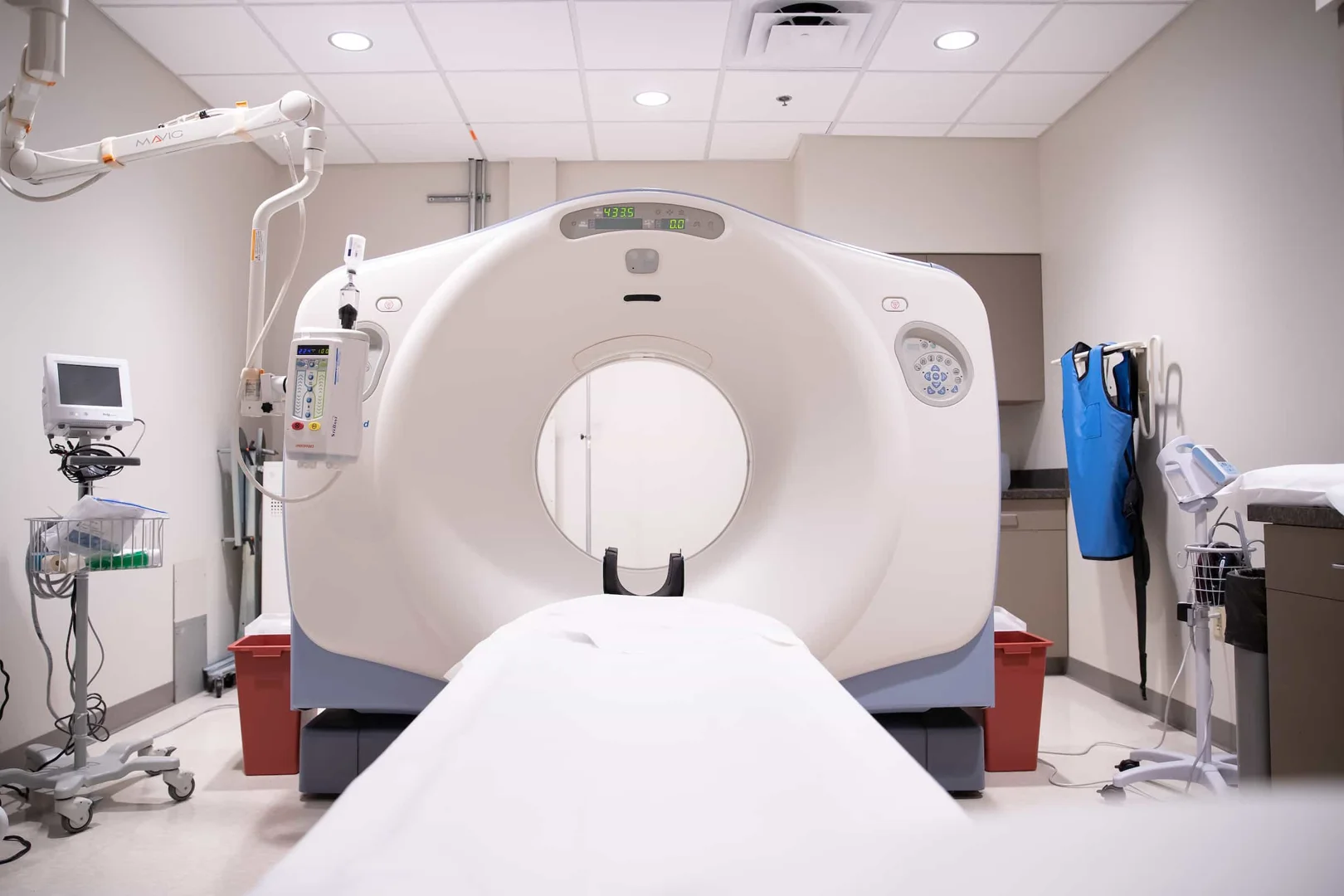
What is a CT scan? It's a medical imaging test that combines a series of X-rays taken from many different angles, then uses a computer to assemble those images into detailed cross-sectional "slices" of the inside of your body — showing bones, blood vessels, and soft tissues far more clearly than a standard X-ray ever could.
Here's a quick summary:
If your doctor has recommended a CT scan, you're not alone — over 80 million CT scans are performed in the United States every year. It's a common and valuable diagnostic tool in modern medicine.
At Advanced Medical Imaging, our fellowship-trained radiologists are here to make sure your scan is read accurately and your results are communicated clearly. We're here for you every step of the way — from your first question to your final report. Conveniently located with same-day appointments available, and open 7 days a week to fit your schedule.
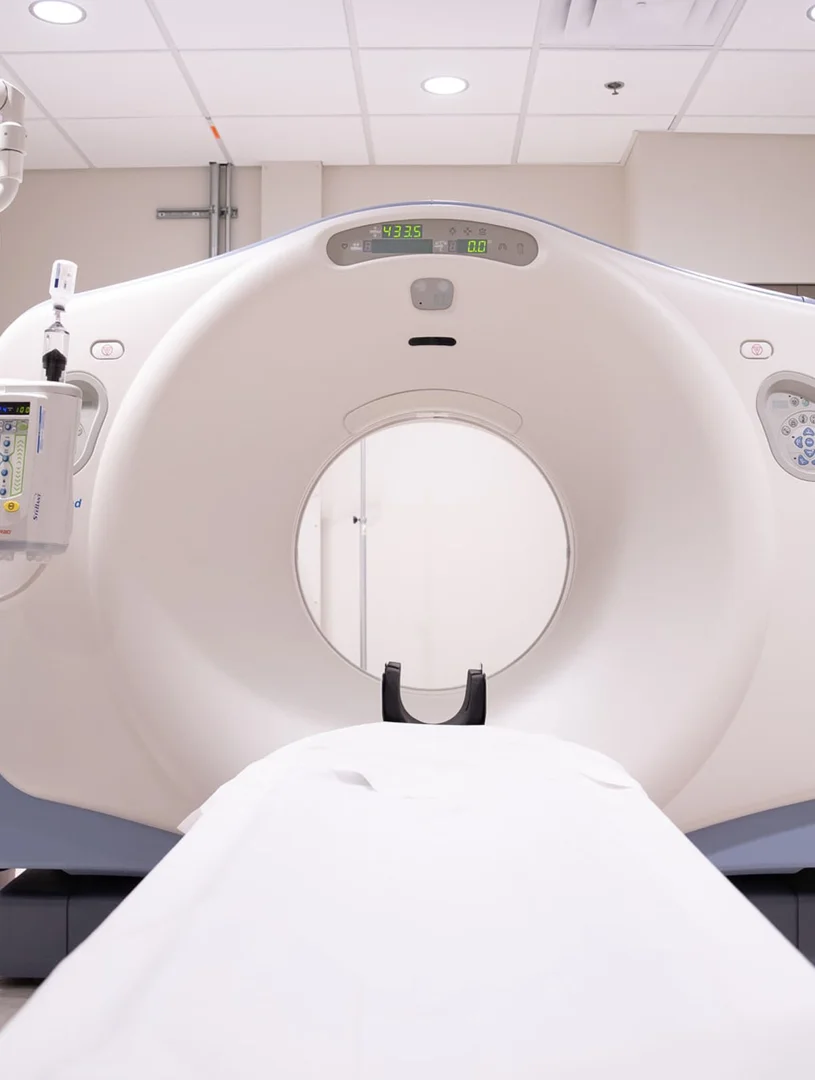
To understand what a CT scan is, it helps to think of a standard X-ray as looking at a closed book. You can see the cover and maybe the general shape, but you can't see the individual pages. A CT scan, or computerized tomography, allows us to "open the book" and look at each page one by one.
By using advanced X-ray techniques, the scanner captures multiple images from different angles around your body. A powerful computer then processes this data to create cross-sectional slices. These slices show your bones, blood vessels, and soft tissues in incredible detail. In many cases, we can even perform a 3D reconstruction, stacking these slices to create a three-dimensional model of an organ or a complex fracture. This level of detail is why Computed Tomography (CT) - Harvard Health notes that CT images provide significant information compared to plain X-rays.
The "magic" happens inside the large, doughnut-shaped machine called a gantry. As you lie on the motorized table, an X-ray source rotates rapidly around you within the gantry. Opposite the X-ray source are digital detectors that capture the beams as they pass through your body.
Different tissues absorb radiation at different rates. Dense structures like bone appear white, while softer tissues appear in various shades of gray. This is measured on the Hounsfield scale, a quantitative scale for describing radiodensity. According to the CT scan: MedlinePlus Medical Encyclopedia, these measurements are converted into digital pixels that form the final image. Modern spiral or helical scanners can now image the entire body in under 30 seconds, making the process faster and comfortable.
Because it can visualize nearly every part of the body, a CT scan is a versatile tool for our team. We use it to diagnose a wide range of conditions, including:
For more information on how we use these tools to help you, explore our imaging services.
Preparing for your visit at Advanced Medical Imaging is usually very straightforward. Depending on the area being scanned, we may ask you to follow specific fasting instructions — often avoiding solid food for four hours prior if contrast material is being used.
We recommend wearing comfortable, loose-fitting clothing. You will need to remove any metal objects, such as jewelry, eyeglasses, dentures, or hairpins, as metal can interfere with the X-ray beams and create "artifacts" on the images. If there is any possibility that you are pregnant, please let our team know immediately. While the radiation risk to a fetus is low, we always prioritize a safe imaging path for you and your baby. You can find more specific details about CT scans on our dedicated service page.
When you arrive at our facility in Lincoln, Nebraska, our goal is to make you feel at home. The patient experience is designed to be efficient and stress-free. Our technologists will guide you through the positioning and stay in constant communication with you through an intercom system. Our safety protocols are rigorous, ensuring that every scan meets high clinical standards while keeping you comfortable. As a CT Scan (Computed Tomography Scan) guide explains, knowing what to expect can significantly reduce any anxiety you might feel about the procedure.
Once you are positioned on the table, it will slowly slide into the scanner. You'll hear some whirring and clicking sounds as the gantry rotates, but nothing will touch you. It is very important to stay perfectly still during the scan, as movement can blur the images.
Our technologist might ask you to hold your breath for a few seconds at a time — usually no longer than 15 to 20 seconds. This helps ensure clear pictures of your chest or abdomen. The actual scanning portion of the appointment often takes less than five minutes. Afterward, you can typically return to your normal daily activities immediately.
Safety is our top priority. Our team follows the ALARA principle — "As Low As Reasonably Achievable" — meaning we use a low dose of radiation necessary to get a high-quality diagnostic image. While CT scans involve more radiation than a standard X-ray, the risk from a single scan is very small. For our younger patients, we use pediatric-adjusted settings to further minimize exposure.
In some cases, we use an IV contrast material (often containing iodine) to highlight blood vessels or specific organs. This helps our radiologists see structures more clearly. If you have a known iodine allergy or kidney function issues, please tell us in advance. We may perform a quick blood test to ensure your kidneys can safely process the contrast. As the American Cancer Society points out, drinking plenty of fluids after your scan can help flush the contrast from your system within 24 hours.
Once your scan is complete, the images are sent to one of our fellowship-trained radiologists. These are doctors who have undergone extra years of specialized training to become experts in interpreting medical images. They will carefully review every "slice" and prepare a detailed report for your healthcare provider.
Your doctor will then discuss the findings with you to determine the next steps in your care. At Advanced Medical Imaging, we pride ourselves on providing rapid, accurate results. We understand that waiting for answers can be difficult, which is why we offer same-day appointments and are open 7 days a week to fit your schedule. We're here for you every step of the way.
If you or a loved one needs a scan, you can easily request a CT scan appointment through our website or by calling our Lincoln office.
While both provide detailed internal images, they use different technologies. A CT scan uses X-rays and is generally faster, making it excellent for looking at bones, lungs, and emergency situations like internal bleeding. An MRI uses powerful magnets and radio waves, which is often preferred for looking at soft tissues like ligaments, tendons, and the spinal cord.
Yes. Unlike an MRI, which uses strong magnets that can interfere with metal implants, a CT scan is generally safe for patients with pacemakers, joint replacements, or other metallic implants.
Some patients experience a warm, flushing sensation throughout their body or a metallic taste in their mouth when the IV contrast is injected. This is completely normal and usually fades within a minute or two. Some people even feel like they have "wet their pants," but don't worry — it's just a sensation caused by the contrast!
.png)


